Where to Put Security Cameras on a House in Perth
8 min readHome CCTV Perth
The short answer
The best place to put a security camera is wherever a person has to pass to get onto your block, mounted at a height where the camera records a face rather than the top of a head. On a typical Perth home that means the front door, the driveway, the side access gate and the rear alfresco, with roughly two and a half metres being the working height for most positions. Getting the angle and the night view right matters more than adding extra cameras.
Summarise with AI
Key Highlights
- Work out the ways onto your block first, then place cameras on those paths
- Around two and a half metres is the height where a camera still sees a face
- Gable mounts look tidy and sit too far above a face to identify anybody
- Point the driveway camera across the drive, not straight down it, so headlights do not blow out plates
- Check every angle after dark, because infrared bouncing off a wall ruins a good daytime view
- Perth eaves, roof pitch and asbestos era sheeting all limit where a camera can physically go
Start With How Someone Gets Onto Your Block
Camera placement is not about the house. It is about the ways a person can get onto your block and where they have to walk once they are on it. Establish those first and the camera positions almost choose themselves.
Stand at your kerb and walk the property the way a stranger would. Up the front path, down the driveway past the cars, through the side gate and along the paving to the back yard.
- The front door and the path that leads to it, which is where deliveries and most visitors happen
- The driveway, including the verge and the kerb where a car pulls up
- Every side gate, because that is the usual route into the back yard
- The rear boundary if you back onto a laneway, a reserve, a park or a school oval
- The garage or workshop door, especially if bikes, tools or a boat live in there
- Any second frontage, which corner blocks and battle axe blocks almost always have
Most Perth blocks have fewer real entry points than people expect. A standard single storey home with a fenced back yard often has three: the front, one side gate, and the driveway. That is a manageable number to cover properly.
The point of listing them is that a camera on a path beats a camera on a wall. A person can avoid a wall. They cannot avoid the gate they have to walk through.
The Height Mistake That Ruins Most Footage
The single most common placement mistake is mounting too high. A camera tucked up under a two storey gable is out of reach and looks neat from the street, and from that height the lens records roof tiles and the crown of a head rather than a face.
Bring the same camera down to roughly two and a half metres and it starts recording faces. That is high enough to be out of casual reach and low enough that the lens is looking at a person rather than down on one.
Height is a trade off, not a rule
Higher means a wider view and less chance of the camera being tampered with. Lower means detail you can identify somebody from. On a house, identification is usually worth more than coverage, so we lean low and add a second camera if the wide view matters.
There is a related mistake with angle. A camera aimed steeply downwards sees the top of everything and the front of nothing. The lens should be looking roughly along the path a person walks, tilted down far enough to keep the ground in frame.
Where the Cameras Go on a Perth House
Positions are worked out standing in the yard, not off a floor plan. That said, most Perth homes end up with a similar core set, because most Perth homes are laid out in a similar way.
| Position | What it is there for | What we watch for |
|---|---|---|
| Front door or porch | Faces at close range, deliveries, anyone who knocks | Mount beside the door rather than above it, or you record heads not faces |
| Driveway | Cars in and out, plates, the verge and the kerb | Angle across the drive so headlights do not wash out the picture |
| Side access gate | The route most people take to reach the back yard | Narrow side runs need a wide lens or the camera records only fence |
| Rear alfresco or patio | Back doors, windows, the yard and the shed | Trim the detection area or the sea breeze in the plants triggers it all night |
| Garage or workshop door | Bikes, tools, the boat, the second car | Roller doors bounce infrared straight back, so position the camera off to one side |
| Second frontage on a corner block | The side street and the second gate people forget about | Easy to skip at quoting time and the first thing missed later |
Scroll the table sideways to see every column.
Notice that none of those positions are about watching the house. They are about watching the ways in. A camera pointed at a blank brick wall records a blank brick wall very sharply.
Getting the Driveway Camera Right
The driveway camera is the one people most often want and most often get wrong. Aimed straight down the drive it faces oncoming headlights, and at night those headlights turn the number plate into a white smear.
Angling across the driveway instead solves most of it. The camera sees the side of the car and the plate as it passes rather than staring into the lights, and it picks up whoever gets out.
- One camera aimed across the drive for plates and people, rather than one aimed along it
- Keep the verge and the kerb in frame, since that is where a car often stops
- Mask out the road and the footpath afterwards so passing traffic does not trigger alerts
- Watch for the sensor light on the garage, which can flare the picture every time it switches on
- Reticulation heads throwing spray across the lens at five in the morning will fog the view and set off motion
A plate at thirty metres is demanding for any camera at a house. If reading plates matters to you, that changes the lens choice and the position, and it is worth saying so before the quote rather than after.
Positions That Look Sensible and Are Not
Some spots seem obvious and quietly produce useless footage. They are worth knowing about because they are exactly where a kit ends up going when nobody has thought it through.
- Inside a window looking out, where the glass reflects the camera's own infrared straight back and the night view is a white sheet
- High in a gable, which is safe from tampering and too far from a face to identify anybody
- Directly above a door, where the only thing in frame is the crown of a head
- Facing a west wall in the afternoon, which turns everyone into a silhouette against the glare
- Tight against a gutter or downpipe, since the infrared bounces off it and floods the lens
- Aimed through a security screen or a flyscreen, which sits between the lens and the visitor
- Pointed across a neighbour's yard or into their windows, which is a problem for reasons that have nothing to do with picture quality
That last one deserves its own thought. A camera that overlooks a neighbour's private space can create a dispute you did not want, so views get framed to your own block wherever they can be.
What Perth Eaves and Roofs Will Allow
The ideal position and the achievable position are not always the same thing. Where a camera can go depends on what is behind the surface you want to fix it to, and how the cable is going to reach it.
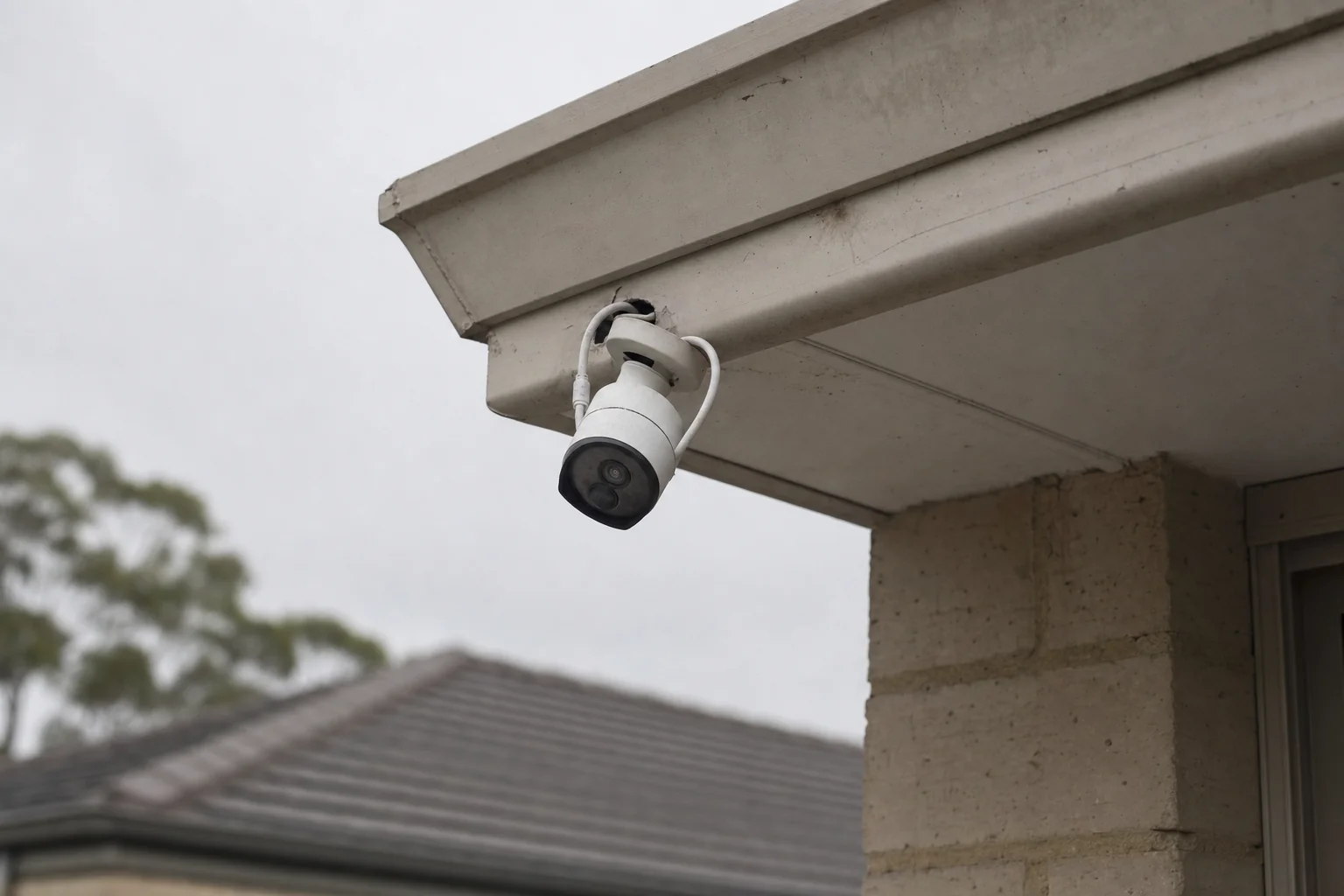
Most Perth homes are double brick with a tiled or Colorbond roof, and cameras usually mount to the timber fascia or the eave lining with the cable dropping straight into the roof space. That keeps the outside of the house clean, with nothing stapled along the gutter line.
- Tiled roofs are relatively easy to move through, so camera positions stay fairly open
- Low pitch Colorbond roofs are a tight crawl, so cameras go where a person can physically reach with a cable
- Homes built before the late 1980s often have eave sheeting that may contain asbestos, and it is not drilled, so the camera moves to a timber fascia, a barge board or the wall
- Two storey homes generally have roof space above the top floor only, so lower cameras get fed down a wall cavity or given a short hidden external run
- Flat and skillion roofs with no crawl space usually mean neat conduit painted to match the wall
- Wide eaves shade the lens, and very shallow eaves leave the camera exposed to driving rain from a westerly
Near the coast there is one more consideration. Salt air works on housings, brackets and cable glands, so seaward facing positions are chosen with more care about shelter.
Plan the Layout Before Anything Is Drilled
Every hole in your eaves is permanent, so the sensible order is decide, agree, then drill. This is the part of the job that costs nothing and saves the most.
Walk the block and list the ways in
Front, driveway, each side gate, the rear boundary, the garage. Anything a person can walk through goes on the list, including the gate nobody uses.
Decide what each camera is for
Identifying a face, reading a plate, or just knowing something happened. Those are different jobs and they need different positions and lenses.
Check the mounting surface
Timber fascia, eave lining, brickwork or a barge board, and what the cable has to do to get there from the roof space.
Stand where the camera will be
Hold a phone at the height and angle you are considering and look at the picture. It is a rough guide and it catches obvious problems before a bracket goes up.
Get the plan in writing
Camera count, positions and where the recorder lives, agreed before the work starts. Moving a camera on paper is free.
Check every angle after dark
A view that looks perfect at two in the afternoon can be a white blur at two in the morning. Night is when these cameras earn their keep.
If you would like help working out the positions at your own place, we attend, walk the block with you and put the layout in writing before anything is touched. The quote is free and no holes are drilled until you have agreed to the layout.
Free written quote
Want the Property Assessed
We walk the property with you, work out the positions, and put the number in writing before anything is touched.
Questions People Ask
What is the best place to put a security camera on a house?
On the paths people have to use to get onto your block, rather than on the biggest wall. For most Perth homes that means the front door, the driveway, the side access gate and the rear alfresco. Height matters as much as position, so around two and a half metres tends to give a picture you can identify somebody from.
How high should a security camera be mounted?
Roughly two and a half metres suits most positions on a house. That is high enough to be awkward to reach and low enough that the lens is looking at a face rather than the top of a head. Cameras mounted up in a gable are safe from tampering and rarely give you anything you can identify a person from.
Can I put a camera inside a window pointing out?
You can, and at night it usually fails. The camera's own infrared reflects off the glass and comes straight back into the lens, so the picture turns into a white sheet as soon as it gets dark. Glass also picks up reflections from inside the room. An outdoor camera under the eave gives a far better result.
Will my camera see a number plate on the driveway?
It depends on the distance, the lens and the angle. Aimed straight down the drive, headlights at night will usually wash the plate out. Angled across the driveway so the camera sees the side of the car as it passes works much better. If reading plates is important to you, say so before the quote so the position and lens are chosen for it.